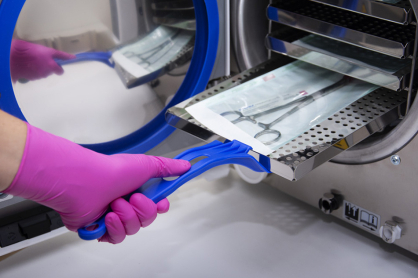
Biological Sterilisation Tests: In-House or Laboratory? A Cost Comparison
Short answer: if you carry out at least 15 biological tests per year, your own incubator pays for itself within the first year and is the least expensive option in the long run. Below you will find exact figures and a comparison table to help you make the right choice for your clinic.
Biological sterilisation indicators are widely available, which means the entire biological testing procedure can be completed in-house. Alternatively, you can send samples to a commercial laboratory or submit them to your local health or sanitary authority. Which option makes more sense?
Contents
How Often Are Biological Tests Required? A Quick Reminder
This section focuses on small medical practices (including dental clinics) and beauty industry facilities (cosmetic salons, nail studios, podiatry clinics, tattoo studios, etc.) using steam sterilisers — the most common type of autoclave in these settings.
Every sterilisation cycle, even in the smallest autoclave, must be accompanied by a routine chemical test that confirms the required temperature, pressure and exposure time were reached. Biological testing serves a different and additional purpose: it confirms that the steriliser is actually capable of eliminating micro-organisms.
 For small clinics and salons, a biological test is most frequently recommended (check your national requirements):
- after commissioning a newly purchased autoclave
- after any service intervention (repair or scheduled maintenance)
- on a regular basis – ideally weekly, but no less than once a month (check the specific requirement with your local health or sanitary authority)
- every time implants intended for placement inside the body are sterilised
For a single autoclave in a small clinic, this means between 12 and 52 tests per year — and it is this number that determines which option will be more cost-effective for you.
It is also essential to include a positive control indicator (from the same product batch) in every test procedure. This indicator is not sterilised; it is incubated alongside the tested ampoules to confirm that the biological material was active and capable of growth before sterilisation.
Ampoule or Sporal Test – Which Type Should You Buy?
Before comparing costs, it is important to understand the difference between the two main types of biological indicator:

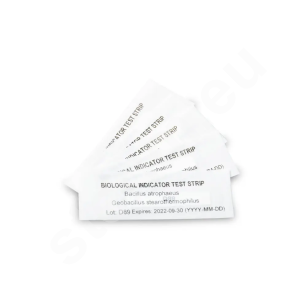
Sporal test (spore strip) – contains only a suspension of bacterial spores, with no growth medium included. After sterilisation, the strip must be sent to an external laboratory, which carries out the incubation and returns the result. Used when working with a commercial laboratory or a public health authority.

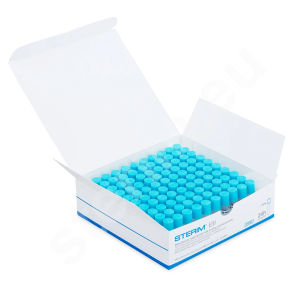
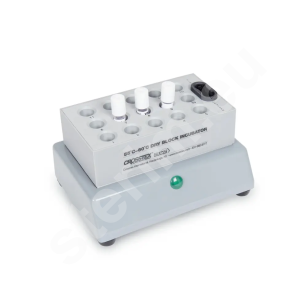
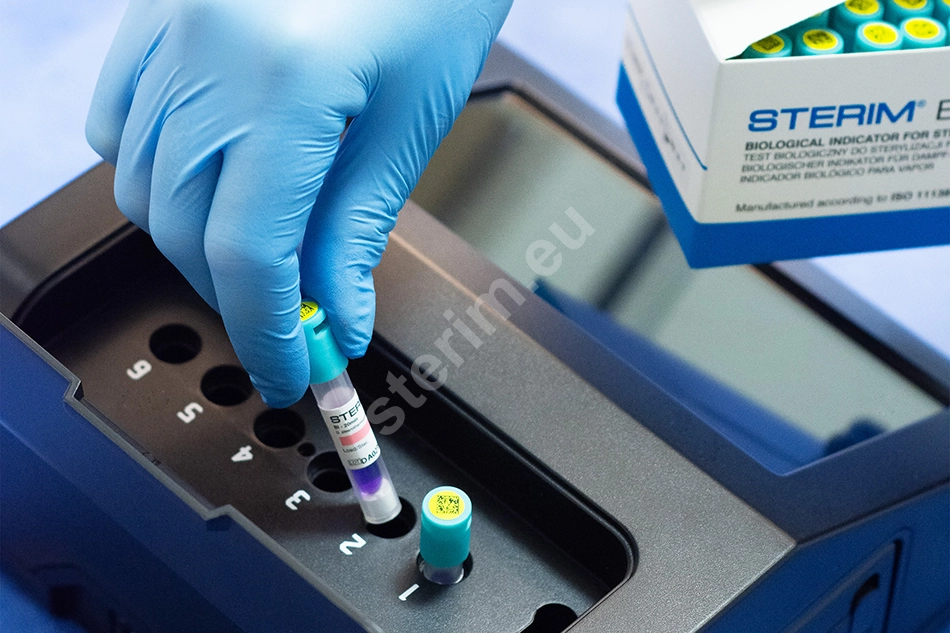
Ampoule biological tests (e.g. STERIM) – contain bacterial spores and a ready-to-use growth medium in a single ampoule. After sterilisation, you simply crush the inner ampoule to release the medium, place it in an incubator for 24 hours at 55–60°C, and read the result. Designed for in-house incubation.
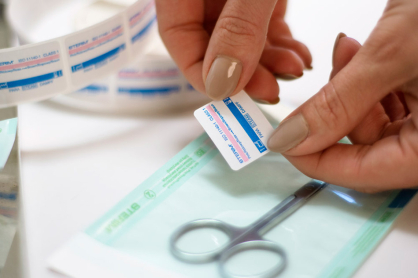
Carrying out the test itself is straightforward. Place the sporal strip or ampoule (inside a sterilisation pouch) in the most critical area of the autoclave chamber — the point where the sterilising agent has the most difficulty penetrating. The number of biological indicators used depends on the size of the autoclave. For small steam sterilisers with a chamber capacity of less than one sterilisation unit, use at least two biological indicators in pouches, or one biological indicator placed inside a PCD (Process Challenge Device) — a load simulation tube.
Cost Comparison: 3 Options for 12 Tests per Year
The figures below are based on 12 tests per year (approximately one per month) — the minimum frequency required for most small clinics. Prices are approximate euro equivalents and will vary by country and supplier.
|
Criterion |
Own incubation (STERIM ampoules) |
Commercial laboratory (courier pick-up)* |
Public health / sanitary authority lab* |
|
Cost of 12 tests – Year 1 |
€310 (24 ampoules + incubator) |
~€280 (24 sporal tests + test fee + courier) |
~€510 (24 sporal tests + test fee) |
|
Cost of 12 tests – Year 2+ |
~€53 ✅ cheapest |
~€280 |
~€510 |
|
Time to result |
24 h (incubation on site) |
2–5 working days |
5–10 working days |
|
Equipment required |
Incubator (~€248, one-off purchase) |
None |
None |
|
Action required from the clinic |
Carry out incubation and read the result |
Hand samples to courier |
Deliver samples to the authority’s laboratory |
|
Documentation / result archiving |
Maintained independently |
Often automated online archiving |
Paper report from the authority |
* The valuations were based on the Polish market.
Note: The costs of the commercial laboratory and public authority options remain constant from year to year. The cost of in-house incubation drops significantly from year two onwards, once the incubator has been fully amortised.
Advantages and Disadvantages of Each Option
Option 1: In-House Incubation with Your Own Incubator
Advantages:
- Lowest cost from year two onwards
- Result within 24 hours – no waiting for a courier or an external laboratory
- Full control over the process – you can repeat the test immediately or quarantine affected instrument sets without delay
- No dependence on the schedules of external providers or public authorities
Disadvantages:
- One-off incubator purchase (~€248) as an upfront cost
- Staff must carry out the incubation and interpret the result – requires training and knowledge of the correct procedure
- Documentation must be maintained independently
- Not cost-effective for clinics carrying out fewer than approximately 12 tests per year
Option 2: Commercial Laboratory with Courier Pick-Up
Advantages:
- No initial capital investment
- Often includes automated online archiving of results
- Less hands-on work for clinic staff
Disadvantages:
- Cost of approximately €23 per test – two to three times more expensive than in-house incubation from year two
- Result after 2–5 working days – if bacterial growth is detected, instruments sterilised during the waiting period may need to be recalled and re-sterilised. In small clinics this is often not practicable
- Dependency on a single supplier – switching providers requires adaptation
- Samples must be stored correctly before collection
Option 3: Public Health or Sanitary Authority Laboratory
Advantages:
- Result comes from an accredited, government-supervised laboratory
- Formally unquestionable in the event of an inspection
Disadvantages:
- Most expensive option – approximately €510 for 12 tests
- Result after 5–10 working days – same instrument-recall risk as with the commercial option, compounded by the longer waiting time
- Samples must be delivered in person or transport must be arranged independently
- The authority’s schedule may be inflexible
- Samples must be stored correctly before submission
Which Option Is Right for Your Clinic?
As a general guide:
- 12 or more tests per year (monthly or more frequent) – consider purchasing your own incubator. The one-off cost is recovered quickly, and from year two the savings are significant.
- Fewer than 12 tests per year – a commercial laboratory with courier pick-up is likely the more practical choice, particularly if automated documentation is important to you.
- One-off statutory requirement or audit – your local public health or sanitary authority laboratory may be the most straightforward option, even though it is the most expensive per test.
Not sure which option suits your clinic?
If you carry out procedures requiring sterilisation on a regular basis, we can help you select the right incubator and ampoule tests for your autoclave and testing schedule. If you are just starting out and are unsure how often biological monitoring is required for your specific type of facility, we can help with that too.
Write to us at info@sterim.eu with a description of your sterilisation frequency and your autoclave model. We will advise you free of charge.
*The valuations were based on the Polish market.